Heart Health
Stroke vs Mini-Stroke: Warning Signs and When to Act
A simple guide to the difference between stroke and mini-stroke, the FAST test, other sudden warning signs, and what to do straight away.
Patient information page | Last reviewed: June 2026
The quick answer
A stroke happens when blood flow to part of the brain is suddenly interrupted. Most strokes happen because a blood clot blocks a blood vessel, but some happen because a blood vessel bursts and bleeds.
A mini-stroke, also called a transient ischaemic attack or TIA, causes the same sudden warning signs, but the blood supply disruption is temporary and the symptoms fully resolve within 24 hours.
Both stroke and mini-stroke are medical emergencies. If you see sudden face drooping, arm weakness, speech difficulty, or other sudden neurological symptoms, call an ambulance immediately.
1. Stroke vs mini-stroke: what is the difference?
Stroke and mini-stroke can look exactly the same at the start. The difference is what happens to the blood flow and whether the symptoms fully resolve.
Quick comparison guide
| Feature | Stroke | Mini-stroke, TIA |
|---|---|---|
| What happens? | Blood flow to part of the brain is suddenly interrupted. This is usually from a clot blocking a blood vessel, or less commonly from bleeding into the brain. | Blood flow to part of the brain is temporarily disrupted, usually by a clot that clears. |
| How long does it last? | The symptoms do not quickly go away on their own and need urgent treatment. | The symptoms usually last minutes to hours and fully resolve within 24 hours. |
| Is there lasting damage? | There can be permanent brain damage, disability, or death if treatment is delayed. | By definition the symptoms fully resolve, but it is a major warning sign that a full stroke may follow soon. |
| Is it an emergency? | Yes. Call an ambulance immediately. | Yes. Call an ambulance immediately, even if symptoms have already improved. |
2. The trap of the mini-stroke
A TIA is often called a mini-stroke. Because the symptoms go away, many people make the dangerous mistake of ignoring it or assuming it was nothing serious.
You should never ignore a TIA. It is a powerful warning sign that you may be at high risk of a full stroke in the near future. Urgent assessment allows doctors to look for the cause and start treatment to reduce that risk.
Even if the symptoms disappear while you are waiting, you still need hospital assessment.
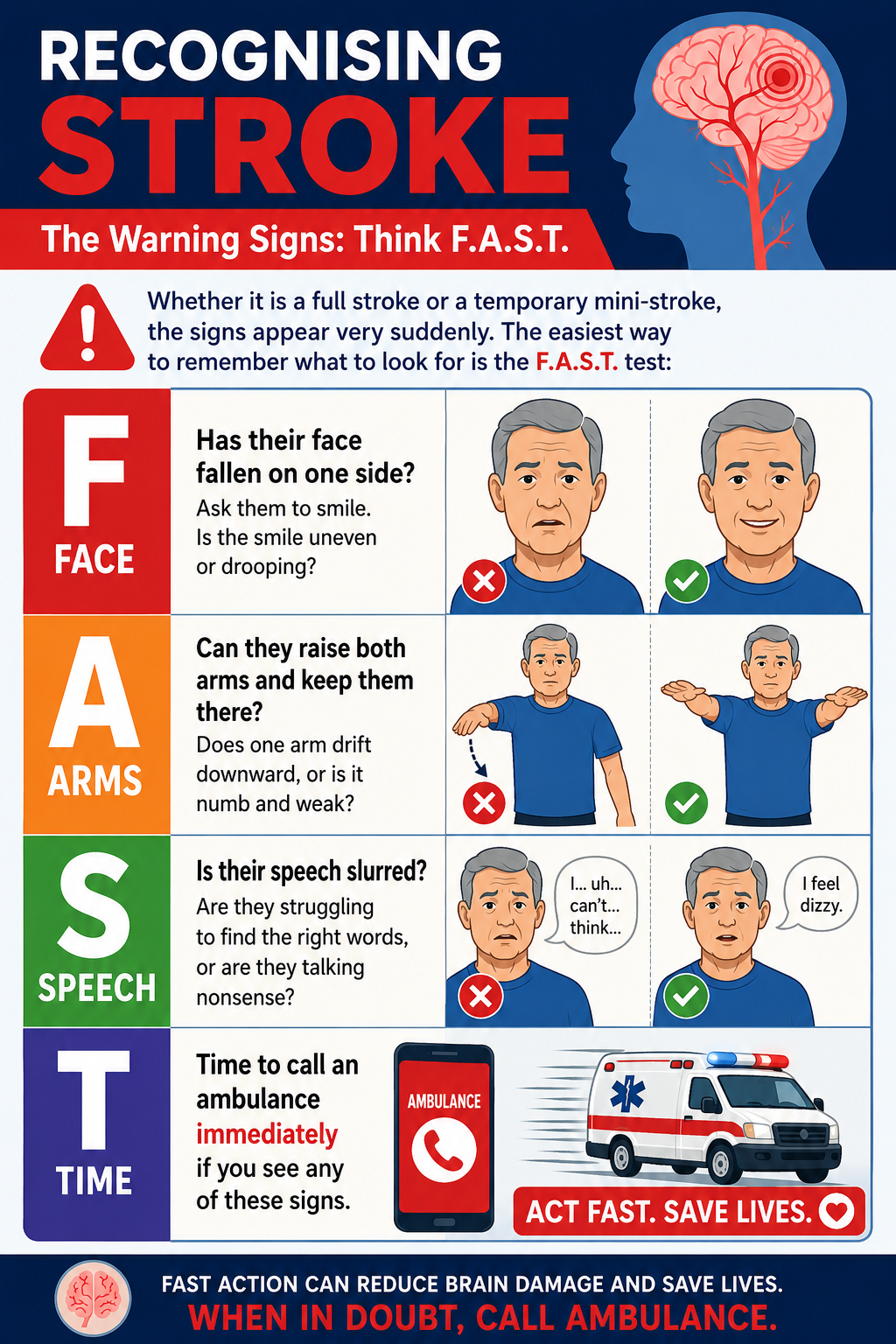
3. The warning signs: think F.A.S.T.
Whether it is a stroke or a mini-stroke, the signs often appear very suddenly. The easiest way to remember them is the FAST test.
F, Face
Has the face fallen on one side? Ask the person to smile. Is the smile uneven or drooping?
A, Arms
Can they raise both arms and keep them there? Does one arm drift down, or is it weak or numb?
S, Speech
Is their speech slurred, garbled, or hard to understand? Are they struggling to find words, or not making sense?
T, Time
Time to call an ambulance immediately if you notice any of these signs.
4. Other sudden signs to watch for
Sometimes a stroke affects parts of the brain that do not cause the classic FAST signs. Seek emergency medical help if you or someone else suddenly develops any of the following.
Vision problems
Sudden loss of vision, double vision, or very blurred vision in one or both eyes.
Balance or coordination problems
Sudden severe dizziness, trouble walking, loss of balance, or suddenly falling for no clear reason.
Severe sudden headache
A sudden severe headache unlike anything you have felt before, especially if it comes with vomiting, neck stiffness, or collapse.
Sudden confusion
Suddenly not understanding what people are saying, looking very confused, or not being able to follow simple instructions.
5. Your emergency action plan
If you suspect a stroke or mini-stroke, do not wait to see if the person feels better.
Call an ambulance immediately
Do not drive yourself or the patient to hospital. Ambulance teams can begin urgent assessment and alert the hospital stroke team.
Note the time symptoms started
If you can, make a note of when the person was last known to be well. This helps the stroke team decide which treatments may be possible.
Keep the person safe and calm
Help them sit or lie down safely. Stay with them and reassure them while waiting for the ambulance.
Do not give food, drink, or medicine
Swallowing may be unsafe during a stroke. Do not give aspirin or any other medicine unless the emergency team tells you to.
Watch for changes
If the person becomes unresponsive or stops breathing normally, begin CPR if you know how and follow emergency dispatcher instructions.
Urgent help box
Call an ambulance immediately if you notice sudden face drooping, arm weakness, speech difficulty, sudden vision loss, severe dizziness, sudden confusion, or a severe sudden headache.
Even if the symptoms quickly improve, it still needs emergency assessment because it may be a TIA.
Key message
Stroke and mini-stroke share the same sudden warning signs. A mini-stroke is not harmless. It is often the warning that a bigger stroke may happen soon.
Think FAST, act quickly, and call an ambulance immediately.
References
- NHS. Stroke.
- NHS. Transient ischaemic attack, TIA.
- American Stroke Association. Stroke symptoms and warning signs.