Heart Health
Cholesterol: What Do My Results Mean?
A simple guide to cholesterol, triglycerides, and what your blood test results may mean.
Patient information page | Last reviewed: June 2026
The quick answer
Hearing that you have high cholesterol can feel worrying, but a cholesterol result is best understood as a pattern, not as one scary number. Cholesterol is a waxy, fat-like substance your body needs. The concern is having too many harmful cholesterol particles in the blood over time, because these can build up inside artery walls and increase the risk of heart attack, stroke, and poor circulation.
What is cholesterol?
Cholesterol is a waxy, fat-like substance made mainly in the liver. It travels in the blood to different parts of the body.
Cholesterol itself is not bad. Your body needs it to build cell walls, keep the brain and nerves healthy, make important hormones such as oestrogen, testosterone, and cortisol, make vitamin D, and make bile acids that help digest fats.
The problem starts when there is too much of the wrong type of cholesterol in the blood.
Understanding the main types
Cholesterol and fats travel through the blood in tiny transport particles called lipoproteins.
HDL, high-density lipoprotein
HDL is often called good cholesterol. It helps carry extra cholesterol away from the blood vessels and back to the liver, where it can be processed and removed.
LDL, low-density lipoprotein
LDL is often called bad cholesterol. If there is too much LDL in the blood, it can enter artery walls and contribute to fatty build-up called plaque.
Triglycerides, TG
Triglycerides are another type of fat in the blood. High levels can be linked with excess weight, diabetes, insulin resistance, alcohol, high sugar intake, and some genetic conditions.
Non-HDL cholesterol
Non-HDL cholesterol means total cholesterol minus HDL cholesterol. It represents the main cholesterol particles that can contribute to plaque build-up, including LDL and VLDL.
1. The screening test: non-HDL cholesterol
For routine checks, your doctor will often order a non-fasting cholesterol test. This is helpful because you usually do not need to fast before the test.
It commonly gives total cholesterol, HDL cholesterol, non-HDL cholesterol, and sometimes triglycerides.
Non-HDL cholesterol is often useful in routine care because it gives a good overall picture of the harmful cholesterol particles, not just one part of the result.
If the screening results are abnormal, or if triglycerides are high, your doctor may ask for a fasting lipid profile.
2. The full lipid profile
A full lipid profile gives a more detailed breakdown of blood fats. Sometimes this is done after fasting for 9 to 12 hours, although fasting is not always needed in every setting.
LDL cholesterol
This is the main bad cholesterol and often the main target for treatment.
VLDL cholesterol
VLDL stands for very low-density lipoprotein. It mainly carries triglycerides from the liver to the body.
Triglycerides
This measures fat circulating in the blood. Very high levels can sometimes increase the risk of pancreatitis.
ApoB, apolipoprotein B
ApoB is attached to harmful cholesterol particles, including LDL and VLDL. It can act as a rough count of the number of harmful particles in the blood.
Healthy target levels
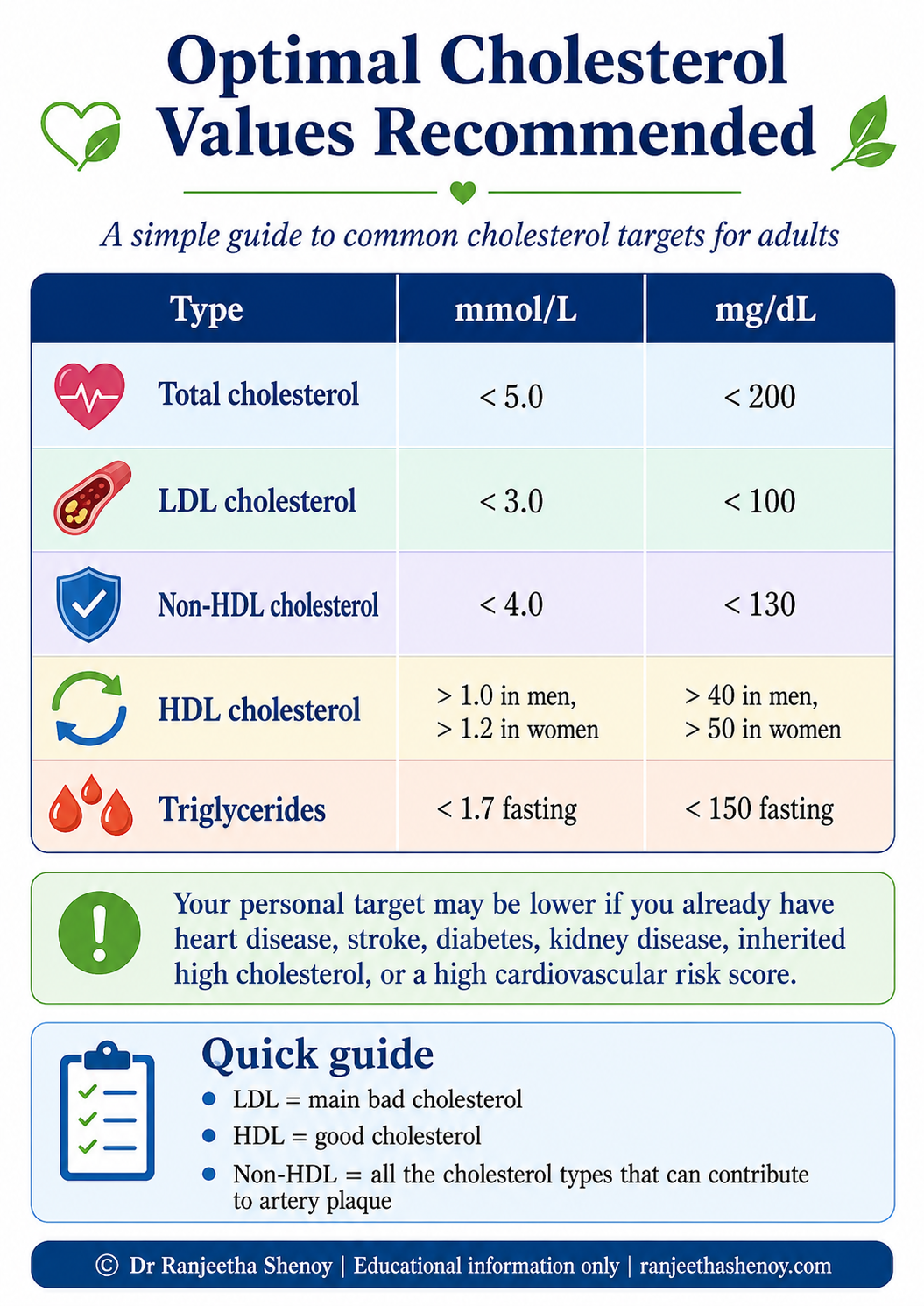
Target levels can be confusing because different countries use different units, and your personal target may be lower if you already have heart disease, stroke, diabetes, kidney disease, inherited high cholesterol, or a high cardiovascular risk score.
UK, USA, and global guidance
Different countries may use different units and slightly different wording, but the overall approach is similar. Modern cholesterol guidance focuses not only on the cholesterol number, but also on a person’s overall cardiovascular risk.
This means your doctor may look at age, blood pressure, smoking, diabetes, kidney disease, previous heart disease or stroke, family history, and cholesterol results together before advising lifestyle changes or medicine.
What if my cholesterol is high?
If your cholesterol is high, the next step depends on how high the numbers are, which part is abnormal, and whether you have diabetes, kidney disease, previous heart disease, stroke, a strong family history, or a high cardiovascular risk score.
Your doctor may recommend lifestyle changes, repeat blood tests, a fasting lipid profile, further blood tests, or cholesterol-lowering medicine such as a statin.
What can help improve cholesterol?
- Eat less saturated fat.
- Avoid trans fats.
- Eat more vegetables, fruits, pulses, oats, nuts, seeds, and whole grains.
- Be physically active.
- Reduce excess weight if needed.
- Stop smoking.
- Reduce alcohol if triglycerides are high.
- Control diabetes if present.
- Take prescribed medicines regularly if advised.
Key message
Cholesterol is not simply good or bad. Your test result is a mix of different fats and lipoproteins. LDL is the main bad cholesterol, HDL is the good cholesterol, non-HDL represents the harmful cholesterol types overall, and triglycerides are another important blood fat.
Your results make most sense when looked at together with your overall health and cardiovascular risk. If you are unsure what your result means, speak to your doctor.
When to seek urgent help
High cholesterol itself usually does not cause urgent symptoms. Seek emergency medical help if you have chest pain or pressure, pain spreading to the arm, jaw, back, or neck, severe breathlessness, sudden weakness on one side of the body, facial drooping, sudden speech difficulty, sudden vision loss, or collapse. Seek urgent help for severe upper abdominal pain, especially if it spreads to the back or comes with vomiting or feeling very unwell, because very high triglycerides can sometimes be linked with pancreatitis.
References
- NHS cholesterol information.
- British Heart Foundation cholesterol information.
- American Heart Association cholesterol guidance.
- European Society of Cardiology guidance on cholesterol and cardiovascular risk.